Computer Science Pathway
Our Computer Science Pathway is a hands-on, project-based program offered through Project Lead the Way (PLTW) — the nation’s leading provider of rigorous and innovative STEM (Science, Technology, Engineering, and Mathematics) education. PLTW’s curriculum engages students in activities, projects, and problem-based (APPB) learning that provides meaningful, real-world experiences. Students create, design, build, discover, collaborate, and solve problems while applying concepts from math and science. They also gain exposure to STEM careers through mentorships and workplace experiences with professionals from local industries, enhancing the real-world relevance of their learning.
PLTW’s comprehensive Computer Science curriculum is developed collaboratively by PLTW educators, university faculty, industry professionals, and school administrators. The program is designed to foster critical thinking, creativity, innovation, and real-world problem-solving skills—preparing students to excel in an increasingly technology-driven world.
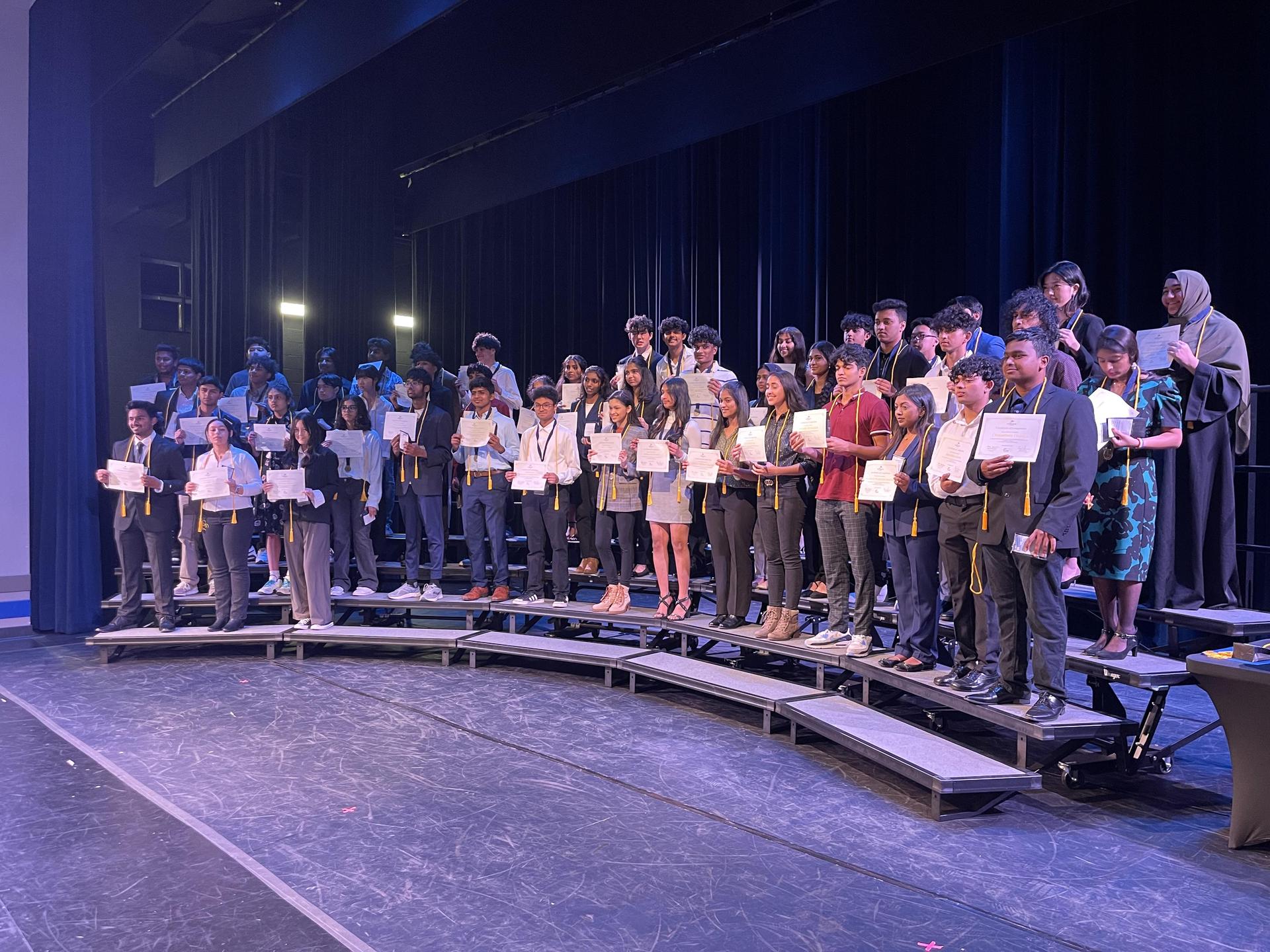
Students in this pathway are also enrolled in a Career and Technical Student Organization (CTSO) that provides students the opportunity to participate in conferences and competitions locally, statewide, and internationally. The organization Computer Science students join is called SkillsUSA.
Students in our Computer Science Pathway engage in a 4-year rigorous honors level course sequence that allows them to gain hands-on experience, access to professionals in the biomedical field, and culminate in projects and internships that are a great lead-in to future studies in the computer science field in college and beyond. Below is the list of our Computer Science courses in our pathway:
Computer Science Essentials
Computer Science Essentials (CSE) is an entry level course in which students will explore the major concepts, big ideas, and computational thinking practices used by computing professionals to solve problems and create value for others. This foundational course is required for all future courses in the Computer Science Pathway, serving as the essential prerequisite for Computer Science Principles and Computer Science A. Through block coding using MIT App Inventor and VEXcode and text-based coding using Python, students engage in hands-on projects that build essential programming and problem-solving skills while developing the confidence to excel in advanced computer science studies.
AP Computer Science Principles
Advanced Placement (AP) Computer Science Principles (APCSP) is an AP course and exam offered by the College Board, giving high school students the opportunity to earn college credit for a college-level computing course. Using Python® as a primary tool, students explore career paths that utilize computing while discovering tools that foster creativity and collaboration. In Unit 1: Creative Computing for All, students learn coding fundamentals and gain a foundation in computational thinking. Unit 2: Every Bit of the Internet introduces networks and how information travels, while Unit 3: Little Data to Big Data focuses on collecting, processing, analyzing, and interpreting data. In Unit 4: Solving Complex Problems, students apply their skills to model and simulate complex systems using computer algorithms. By the end of the course, students are prepared to tackle real-world computing challenges and take the AP Computer Science Principles exam for potential college credit.
Prerequisites: Computer Science Essentials
AP Computer Science Advanced
Advanced Placement (AP) Computer Science A (APCSA), also known as AP CompSci or AP Java, is an AP course and exam offered by the College Board that allows high school students to earn college credit for a college-level computer science course. Students cultivate their understanding of coding by analyzing, writing, and testing code while exploring key concepts such as modularity, variables, and control structures. Unit 1: Java Coding Fundamentals introduces students to the basics of Java programming, followed by Unit 2: Iterations and Classes, which emphasizes loops and object-oriented programming. In Unit 3: Arrays and ArrayLists, students learn to store, access, and manipulate collections of data, while Unit 4: Data Organization focuses on structuring and organizing data effectively. This College Board-endorsed course also offers students the opportunity to take the AP Computer Science A exam for potential college credit.
Prerequisites: Computer Science Essentials
Applied Computer Science Topics
This advanced programming course is designed for students with a foundational understanding of object-oriented programming. In Semester 1, students will deepen their knowledge of Java while preparing for the Oracle Java Certification, gaining industry-recognized credentials to validate their programming skills. The course will also introduce core mobile application development concepts using Android Studio, emphasizing GUI design, logical reasoning integration, memory management, and database connectivity.
In Semester 2, students will apply their skills toward the development of a capstone project, which may be completed in any object-oriented programming language of their choice. This project will showcase their ability to design, build, and present a fully functional software application, following industry-standard development tools, workflows, and design principles.
Prerequisites: Computer Science Essentials, AP CS A or AP CS PWhat’s New:
Game Design
In this course, students will explore the foundations of game design using JavaScript through the engaging CodeHS curriculum. They will learn how to create interactive games and animations while developing a strong understanding of programming concepts. Students will experiment with graphics, user interaction, and basic game mechanics to bring their ideas to life on the screen. Throughout the course, they will practice problem-solving, creativity, and logical thinking as they design and code original projects. No prior programming experience is required—this course is open to all students interested in technology and design.
Future Courses:
AP Networking
Advanced Placement (AP) Networking is an AP course and exam offered by the College Board that provides high school students the opportunity to earn college credit for a college-level networking course. Students develop a deep understanding of networking concepts by designing, configuring, and securing networks. Unit 1: Configuring and Securing a Device introduces students to basic device setup and security practices. In Unit 2: Building a LAN and Unit 3: Securing a LAN, students learn to construct local area networks and implement measures to protect them. Unit 4: Building a WAN and Unit 5: Securing a WAN focus on designing wide area networks and ensuring their security in complex environments. This College Board-endorsed course also gives students the opportunity to take the AP Networking exam for potential college credit, preparing them for further studies and careers in IT and network administration.
AP Cybersecurity
Advanced Placement (AP) Cybersecurity is an AP course and exam offered by the College Board that allows high school students to earn college credit for a college-level cybersecurity course. Students develop essential skills to protect digital systems by analyzing threats, implementing security measures, and understanding best practices in the field. Unit 1: Developing a Cyber Mindset introduces students to cybersecurity thinking, risk assessment, and ethical practices. In Unit 2: Securing Physical Spaces and Unit 3: Securing Networks, students learn to protect both physical infrastructure and networked systems from vulnerabilities. Unit 4: Securing Devices and Unit 5: Securing Applications and Data focus on safeguarding hardware, software, and sensitive information against cyberattacks. This College Board-endorsed course also prepares students to take the AP Cybersecurity exam for potential college credit while equipping them with practical skills for future studies and careers in cybersecurity.
Students who are involved in the Computer Science Pathway are also involved with the national Skills USA organization. Students in this organization participate in conferences and competitions locally, statewide, and internationally.
For more information, please contact the Pathway teachers,
Padmavathy Jawahar, at [email protected]t
Fatma Hammam, at [email protected]t
Sampurna Sarkar, at [email protected]
Arunthathi Murugesan, at [email protected]